For two decades, the enterprise data warehouse was synonymous with a dedicated appliance: Teradata for the largest banks, Netezza for analytics-heavy retailers, Oracle Exadata for Oracle shops, and on-premise SQL Server for everyone else. These systems delivered exceptional query performance through massively parallel processing (MPP) engines, columnar storage, and hardware-software co-design. They also came with exceptional price tags, rigid capacity models, and deep vendor lock-in.
Microsoft Fabric represents a new architectural category — not just a cloud data warehouse, but a unified analytics platform that subsumes the warehouse, the data lake, the ETL engine, the ML platform, and the BI tool into a single, consumption-based service. For enterprises evaluating their next platform investment, understanding how Fabric differs from the traditional model is essential to making the right decision.
The Traditional Data Warehouse Architecture
Teradata, Netezza, Oracle Exadata, and on-premise SQL Server represented the gold standard for decades. Dedicated appliances, MPP query engines, and proprietary SQL extensions delivered performance — at a steep price.
The architecture was straightforward: buy hardware (or lease an appliance), install the vendor's database engine, load data through ETL pipelines, and run queries. Performance was predictable because capacity was fixed — you knew exactly how many nodes you had, how much storage was available, and how many concurrent queries the system could handle.
This model worked well in an era of structured data, batch processing, and predictable query patterns. A bank running nightly risk calculations against a stable schema could size a Teradata appliance once, tune it for that workload, and run it for years with minimal architectural changes. The vendor provided the hardware, the engine, the optimizer, and the support — a complete, self-contained solution.
The proprietary SQL extensions that each vendor developed — Teradata's BTEQ scripting, Oracle's PL/SQL, Netezza's SQL extensions for analytics, SQL Server's T-SQL with CLR integration — became deeply embedded in application logic. Stored procedures running business-critical calculations, ETL scripts encoding data quality rules, and reporting queries with vendor-specific syntax all created tight coupling between the application layer and the database platform.

Azure Fabric — enterprise migration powered by MigryX
Limitations Driving Migration
The traditional model is breaking down under six compounding pressures:
- Fixed capacity, no elastic scaling. Traditional warehouses are sized for peak load, which means paying for maximum capacity 24/7 even when utilization is 10% during off-hours. Adding capacity requires hardware procurement, installation, and data redistribution — a process measured in weeks or months, not minutes.
- Hardware refresh cycles. Appliances have a three-to-five-year lifecycle. Each refresh is a major project involving data migration, application testing, and downtime. Organizations often delay refreshes to avoid disruption, running on aging hardware that cannot meet growing performance demands.
- Vendor lock-in with proprietary SQL. Thousands of stored procedures, ETL scripts, and reports written in vendor-specific SQL dialects cannot be ported without rewriting. This lock-in gives vendors pricing leverage and makes platform evaluation nearly impossible without a significant investment in proof-of-concept work.
- Escalating licensing costs. As data volumes grow and more teams demand access, licensing costs scale — often faster than budgets. Teradata's per-node pricing, Oracle's per-core licensing, and Netezza's appliance-based model all create predictable cost escalation that CIOs struggle to justify against cloud alternatives.
- Inability to handle unstructured data. Traditional warehouses were built for structured, tabular data. JSON, images, text, streaming events, and semi-structured logs — the fastest-growing data categories — either cannot be stored at all or require awkward workarounds like BLOB columns and external tables.
- Growing skills gap. The industry's center of gravity has shifted to Python, Spark, and cloud-native tools. New graduates learn pandas and PySpark, not BTEQ and PL/SQL. Organizations maintaining legacy warehouses increasingly face a talent market that has moved on.
MigryX: Idiomatic Code, Not Line-by-Line Translation
The difference between MigryX and manual migration is not just speed — it is code quality. MigryX generates idiomatic, platform-optimized code that leverages native features of your target platform. A SAS DATA step does not become a clunky row-by-row loop — it becomes a clean, vectorized DataFrame operation. A PROC SQL query does not become a literal translation — it becomes an optimized query that takes advantage of your platform’s pushdown capabilities.
How Fabric Differs
Fabric is not simply a cloud-hosted version of a traditional warehouse. It is an architecturally different system built on fundamentally different assumptions:
Compute-storage separation via OneLake. All data lives in OneLake, an open-format storage layer based on Delta Lake (Parquet files with ACID transactions). Compute engines — SQL, Spark, KQL — attach to this storage on demand and scale independently. You never pay for idle compute, and storage costs are a fraction of proprietary appliance storage.
Pay-per-query pricing. Fabric's capacity model lets organizations scale compute up for heavy processing and scale down (or pause entirely) during idle periods. A nightly batch job that needs 100 nodes for two hours does not require paying for 100 nodes the other 22 hours of the day.
Unified platform. Analytics, BI, ML, data engineering, and real-time streaming all run on the same platform, reading from the same storage, governed by the same security model. This eliminates the ETL-to-warehouse-to-BI-tool pipeline that creates data copies, latency, and governance gaps.
Open format. Data stored in OneLake is standard Delta Lake / Parquet. It can be read by any tool that understands Parquet — not just Fabric's engines. If an organization ever needs to move to a different platform, the data is already in an open format. This is the opposite of proprietary appliance storage where data extraction is itself a major project.
Multiple query engines. T-SQL for familiar warehouse workloads. Spark for large-scale data engineering and ML. KQL for streaming and time-series analytics. Each engine is optimized for its workload, but all read from the same OneLake tables. Traditional warehouses offer exactly one query engine — their proprietary SQL implementation.
Copilot AI built in. Fabric's Copilot provides natural-language query generation, automated code suggestions in notebooks, and intelligent pipeline debugging. These AI capabilities are native to the platform, not third-party add-ons. For organizations struggling with skills gaps, AI assistance accelerates onboarding and productivity.
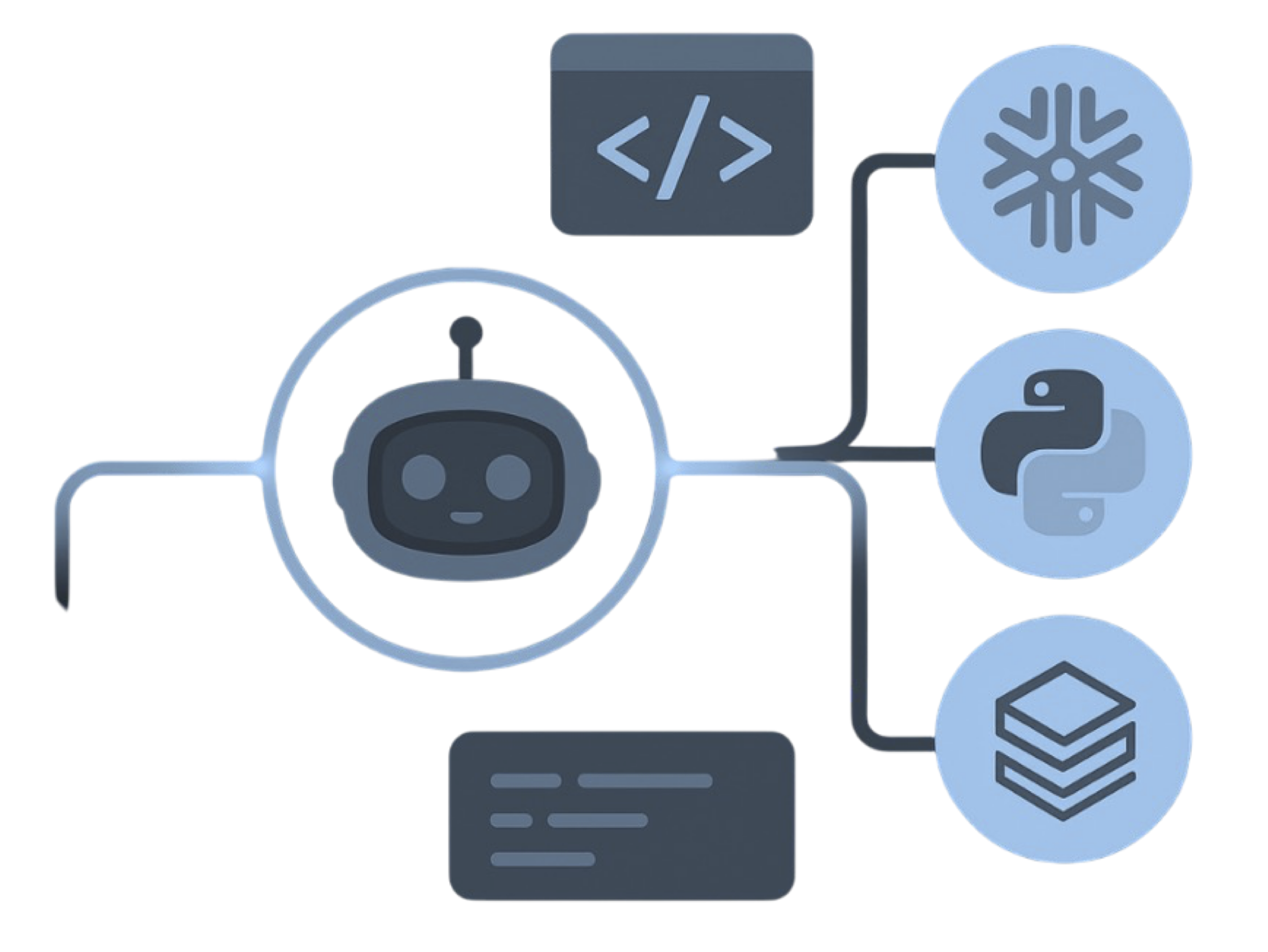
MigryX precision parser — Deep AST-level analysis ensures every construct is understood before conversion begins
Platform-Specific Optimization by MigryX
MigryX maintains deep knowledge of every target platform’s strengths and best practices. When converting to Snowflake, it leverages Snowpark and native SQL functions. When targeting Databricks, it uses PySpark DataFrame operations optimized for distributed execution. When generating dbt models, it follows dbt best practices for modularity and testability. This platform awareness is what makes MigryX output production-ready from day one.
Side-by-Side Comparison
| Dimension | Traditional Data Warehouse | Microsoft Fabric |
|---|---|---|
| Scaling | Fixed capacity; hardware procurement for expansion | Elastic; scale up/down in minutes, pause when idle |
| Storage Format | Proprietary (vendor-specific internal format) | Open (Delta Lake / Parquet on OneLake) |
| Pricing Model | Per-node, per-core, or appliance-based (always on) | Consumption-based (pay for what you use) |
| ML Integration | None native; requires separate ML platform | Native Data Science experience with MLflow |
| BI Integration | Separate BI tool (Tableau, MicroStrategy, etc.) | Power BI integrated; reads directly from OneLake |
| Real-Time Analytics | Not supported or limited; batch-oriented | Native KQL engine for streaming and time-series |
| Data Engineering | External ETL tools (Informatica, DataStage, SSIS) | Native Data Factory and Spark notebooks |
| Governance | Manual catalog; separate lineage tools | OneLake catalog with automatic lineage tracking |
| Unstructured Data | Unsupported or BLOB workarounds | Native support in lakehouse tables |
| AI Assistance | None | Copilot for SQL, notebooks, and pipelines |
| Vendor Lock-in | High (proprietary SQL, proprietary storage) | Low (open formats, standard languages) |
The comparison is not just feature-for-feature. Fabric's architecture eliminates entire categories of infrastructure that traditional warehouses require: separate ETL servers, separate BI servers, separate ML platforms, separate governance tools. The total cost of ownership comparison must account for all of these systems, not just the warehouse license.
Total Cost Perspective
When comparing Fabric to a traditional data warehouse, include the cost of all the tools Fabric replaces: the ETL platform, the BI server, the ML environment, the governance catalog, and the integration glue code that connects them. Fabric consolidates all of these into a single platform with consumption-based pricing.
How MigryX Bridges the Gap
The biggest challenge in moving from a traditional data warehouse to Fabric is not choosing the platform — the architectural advantages are clear. The challenge is getting there. Decades of stored procedures, ETL jobs, and reporting queries written in proprietary SQL dialects all need translation. This is where migration complexity lives, and it is where most initiatives stall.
Consider a typical Teradata estate: thousands of BTEQ scripts encoding data loading logic, FastLoad and MultiLoad jobs for bulk ingestion, stored procedures implementing business rules, and views feeding downstream BI reports. Every one of these artifacts uses Teradata-specific syntax — QUALIFY clauses, SAMPLE functions, MERGE INTO with Teradata semantics, temporal tables, and hash-distributed join optimization hints.
Oracle environments present a different set of challenges: PL/SQL packages with complex cursor logic, hierarchical queries using CONNECT BY, Oracle-specific date arithmetic, and materialized views with refresh dependencies. SSIS packages add visual dataflow logic stored in XML that must be parsed, understood, and reconstructed as Data Factory pipelines.
MigryX handles all of these source dialects automatically:
- Teradata BTEQ scripts are parsed and converted to Fabric Data Warehouse SQL, with Teradata-specific functions mapped to T-SQL equivalents and BTEQ control flow translated to Data Factory pipeline logic.
- Oracle PL/SQL packages are converted to Fabric Spark Notebooks for complex procedural logic or Data Warehouse stored procedures for SQL-heavy workloads, with Oracle-specific syntax (NVL, DECODE, CONNECT BY) translated to standard equivalents.
- SSIS packages are parsed from their XML definitions and reconstructed as Data Factory pipelines with equivalent data flow logic, connection managers, and error handling.
- Custom SQL dialects — including Netezza SQL extensions, IBM DB2 SQL, and legacy SQL Server features — are all handled by MigryX's dialect-aware parser, which understands the semantic differences between superficially similar SQL statements.
For each source artifact, MigryX generates the appropriate Fabric target: Data Warehouse SQL for analytical queries and stored procedures, Spark Notebooks for complex transformations and ML workloads, and Data Factory pipelines for orchestration and scheduling. Column-level lineage is registered in OneLake catalog automatically, ensuring governance from day one.
The transition from traditional data warehouses to Microsoft Fabric is not a question of if, but when. The economic pressures, the architectural limitations, and the skills gap are all accelerating the timeline. The organizations that will succeed are those that invest in automated migration tooling rather than attempting manual rewrites that stretch across years and budgets. Fabric provides the destination. MigryX provides the fastest, most reliable path to get there.
Why MigryX Delivers Superior Migration Results
The challenges described throughout this article are exactly what MigryX was built to solve. Here is how MigryX transforms this process:
- Production-ready output: MigryX generates code that passes code review and runs in production — not prototype-quality output that needs weeks of cleanup.
- Platform optimization: Converted code leverages target platform-specific features for maximum performance and cost efficiency.
- 25+ source technologies: Whether migrating from SAS, Informatica, DataStage, SSIS, or any of 25+ legacy technologies, MigryX handles it.
- Automated documentation: Every conversion decision is documented with before/after code mappings and transformation rationale.
MigryX combines precision AST parsing with Merlin AI to deliver 99% accurate, production-ready migration — turning what used to be a multi-year manual effort into a streamlined, validated process. See it in action.
Ready to move beyond legacy data warehouses?
See how MigryX automates migration from Teradata, Oracle, Netezza, and SQL Server to Azure Fabric — with full lineage and validation.
Schedule a Demo