For decades, SAS has been the gold standard in enterprise analytics. Banks, insurance companies, government agencies, and pharmaceutical firms built entire data ecosystems around SAS software. But the landscape of data science and analytics has shifted dramatically over the past decade, and a growing number of organizations are recognizing that Python represents the logical next step in their analytics evolution.
This is not a story about one tool being inherently superior to another. It is a story about market dynamics, talent availability, innovation velocity, and the unstoppable momentum of open-source technology reshaping the enterprise.
SAS's Changing Market Position
SAS Institute has been a privately held company since its founding in 1976, and for much of its history, it dominated the advanced analytics market. However, recent industry analyses paint a different picture. According to multiple surveys from Stack Overflow, Kaggle, and KDnuggets, SAS usage among data professionals has been declining steadily since 2016, while Python and R have surged.
Several factors are driving this shift:
- Licensing costs: SAS Enterprise licenses can run into hundreds of thousands or even millions of dollars annually for large organizations. As budgets tighten and CFOs demand ROI transparency, the appeal of open-source alternatives grows.
- Talent pipeline: Universities have largely moved to teaching Python and R in statistics and data science programs. Graduates entering the workforce are far more likely to be proficient in Python than in SAS.
- Cloud-native architecture: Modern data platforms like Snowflake, Databricks, and Google BigQuery are designed around Python, SQL, and Spark, not SAS proprietary formats.
- Innovation pace: The open-source community releases improvements and new libraries at a pace no single vendor can match.

SAS to Python migration — automated end-to-end by MigryX
Python's Meteoric Rise in Data Science
Python has become the lingua franca of data science, machine learning, and AI. The TIOBE Index consistently ranks Python as the number one or number two programming language globally. But what makes Python so compelling for organizations considering a move away from SAS?
A Library Ecosystem Without Equal
Python's strength lies in its vast and mature ecosystem of libraries that cover every aspect of the analytics workflow:
- pandas: The de facto standard for data manipulation and analysis. Its DataFrame structure is familiar to anyone who has worked with SAS datasets, and it supports reading from virtually every data format including SAS7BDAT files natively.
- NumPy: The foundation for numerical computing in Python, providing high-performance array operations that underpin most scientific computing libraries.
- scikit-learn: A comprehensive machine learning library offering classification, regression, clustering, and dimensionality reduction algorithms with a consistent, clean API.
- statsmodels: Provides statistical models, hypothesis tests, and data exploration functions that closely mirror many SAS PROC procedures.
- PySpark: Enables distributed computing on Apache Spark, allowing Python code to process datasets far larger than what fits in memory, a critical capability for enterprise-scale analytics.
- matplotlib, seaborn, and plotly: A layered visualization ecosystem from basic static charts to interactive dashboards.
Key Insight
The Python Package Index (PyPI) hosts over 500,000 packages as of 2026. The data science and machine learning category alone contains thousands of actively maintained libraries, ensuring that virtually any analytical task has a well-tested open-source solution.
MigryX: Purpose-Built for Enterprise SAS Migration
MigryX was designed from the ground up for enterprise SAS migration. Its SAS parser understands every construct — DATA steps, PROC SQL, PROC SORT, PROC MEANS, PROC FREQ, PROC TRANSPOSE, macros, formats, informats, hash objects, arrays, ODS output, and even SAS/STAT procedures like PROC REG and PROC LOGISTIC. This is not a generic code translator — it is the most comprehensive SAS migration platform in the industry.
Job Market Trends Favor Python
One of the most compelling arguments for migrating to Python is the talent landscape. Data from LinkedIn, Indeed, and Glassdoor consistently show that Python-related data science roles outnumber SAS-specific roles by a ratio of roughly 8 to 1 in the United States, and the gap is even wider internationally.
For hiring managers, this disparity has concrete consequences. Finding experienced SAS programmers is becoming more difficult and more expensive. Many seasoned SAS professionals are approaching retirement, and the pipeline of new graduates with SAS expertise is thin. Meanwhile, Python developers are abundant, younger on average, and often bring additional skills in machine learning, cloud engineering, and software development best practices.
| Metric | SAS | Python |
|---|---|---|
| Job postings (data science) | ~12% | ~78% |
| Average salary premium | Higher per-role cost | Competitive, larger pool |
| University curriculum coverage | Declining | Near-universal |
| Online learning resources | Limited | Extensive (free and paid) |
| Community forum activity | Moderate | Very high |
Enterprise Adoption is Accelerating
It is one thing for startups and tech companies to embrace Python. It is another for regulated industries such as banking, healthcare, and government to make the switch. Yet that is exactly what is happening.
Major financial institutions, including several of the largest banks in the world, have announced or completed migrations away from SAS to Python-based analytics platforms. The drivers are consistent: cost reduction, talent acquisition, and the ability to integrate analytics more tightly with modern data infrastructure.
Pharmaceutical companies, which have historically relied heavily on SAS for regulatory submissions to the FDA, are also exploring Python. The FDA itself has signaled openness to accepting submissions that use open-source tools, provided proper validation is in place.
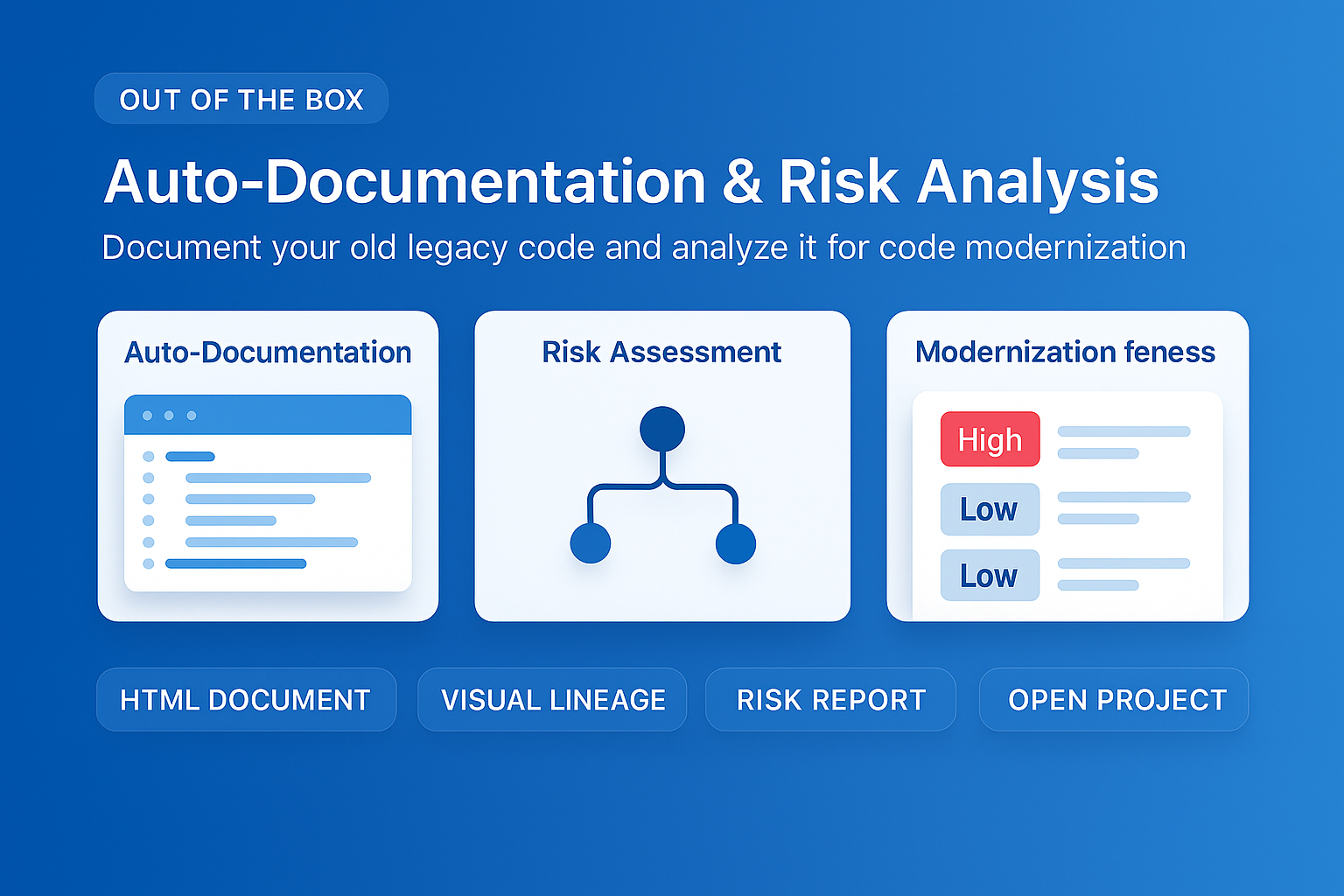
MigryX auto-documentation captures every transformation decision, creating audit-ready migration records automatically
How MigryX Handles the Hard Parts of SAS Migration
Every SAS shop has code that makes migration teams nervous — deeply nested macros that generate dynamic code, DATA step merge logic with complex BY-group processing, hash object lookups, RETAIN statements that carry state across rows, and PROC IML matrix operations. These are exactly the constructs where MigryX excels. Its combination of deterministic AST parsing and Merlin AI means even the most complex SAS patterns are converted accurately.
The Open-Source Advantage
Beyond cost, open-source software offers structural advantages that matter deeply to enterprise technology teams:
- Transparency: Every algorithm, every function, every line of code is open for inspection. There are no black boxes. This is invaluable for regulatory compliance and auditability.
- Extensibility: Organizations can modify, extend, and contribute back to the tools they use. If a statistical method is missing, it can be implemented and shared.
- Vendor independence: No single company controls the Python ecosystem. Organizations are not locked into one vendor's roadmap, pricing, or business decisions.
- Integration: Python connects natively to every major database, cloud platform, and data format. APIs, REST services, and microservices are all first-class citizens in the Python world.
Community Support and Knowledge Sharing
The Python data science community is arguably the most active and supportive in all of software. Stack Overflow questions tagged with "python" number in the millions, with rapid response times. Conferences such as PyCon, SciPy, and PyData draw thousands of attendees and produce hundreds of hours of freely available recorded talks.
This community effect creates a self-reinforcing cycle: more users attract more contributors, who create more libraries, which attract more users. For organizations making the transition from SAS, this means answers to migration questions are often just a search away.
What This Means for Your Organization
The shift from SAS to Python is not a question of if, but when. Organizations that begin planning their migration now will benefit from lower costs, better talent access, and tighter integration with modern cloud data platforms. Those that delay risk falling behind competitors who have already made the move.
However, migration is not trivial. Decades of SAS code, institutional knowledge embedded in macros and data step logic, and regulatory requirements all demand a thoughtful, systematic approach. This is where automated migration tools become essential, transforming what could be a multi-year manual effort into a streamlined, validated process.
The organizations that thrive in the next decade of data analytics will be those that combine the rigor and reliability of their SAS heritage with the flexibility and innovation of the Python ecosystem.
The future of analytics is open, cloud-native, and Python-powered. The question is not whether to make the move, but how to make it efficiently, accurately, and with minimal disruption to your business.
Why Every SAS Migration Needs MigryX
The challenges described throughout this article are exactly what MigryX was built to solve. Here is how MigryX transforms this process:
- Complete SAS coverage: MigryX handles every SAS construct — DATA steps, PROC SQL, macros, formats, hash objects, arrays, ODS, and 20+ PROCs.
- 4-8x faster than manual: What takes consulting teams months of manual conversion, MigryX accomplishes in weeks with higher accuracy.
- 60-85% cost reduction: Enterprises report dramatic cost savings compared to manual migration approaches.
- Production-ready output: MigryX generates clean, idiomatic Python, PySpark, Snowpark, or SQL — not rough drafts that need extensive rework.
MigryX combines precision AST parsing with Merlin AI to deliver 99% accurate, production-ready migration — turning what used to be a multi-year manual effort into a streamlined, validated process. See it in action.
Ready to modernize your legacy code?
See how MigryX automates migration with precision, speed, and trust.
Schedule a Demo